
Playing with Your Dog: The Key to Trust and Self-Regulation

In good play, there is reciprocity. The dog is allowed to influence what happens. The owner sets safe boundaries. Both adjust to each other.
Have you noticed how your dog likes to play with you? Some dogs light up when you bring out a ball. Others love running after you, being invited into a game of chase, or looking for you when you hide behind a tree. Some prefer tug-of-war, where you each hold one end of the toy and feel the strength, rhythm, and cooperation between you. Others enjoy calmer activities, such as searching for treats, discovering small surprises in the environment, or spending time together while using their nose and body at their own pace.
Perhaps you and your dog also have a game that belongs only to the two of you, a small movement, a look or an invitation your dog immediately understands.
Play may seem simple when we look at it from the outside. It can look like fun, a reward, or a way to pass the time. But when we look more closely, much more is happening. In play, dog and human meet in a shared language. The dog reads us, we read the dog, and together we create small moments of joy, expectation, excitement, and cooperation.
This is precisely why play is so valuable when working on relationships, safety, and self-regulation. Play is not only about activity. It is also about emotional flexibility.
What happens when a dog learns that something unexpected does not have to be dangerous, but can become fun? When the dog feels a small moment of excitement or uncertainty, and still quickly finds its way back to safety together with you?
Play is More than Fun
In young mammals and in many adult animals, play has an important function. Through play, the animal practises body control, social communication, self-regulation, and adaptation to others.
Play is often full of small surprises. It contains quick shifts, sudden stops, invitations, exaggerations, pauses, and new beginnings. In good play, the dog can move from expectation to surprise, from high activity to pause, from excitement to joy, and from uncertainty back to safety.
When a dog plays with a safe human, it experiences that the world can be a little unpredictable without being dangerous. Something may suddenly move. The owner may change direction. The play may stop and start again. The dog may become eager, surprised, or slightly frustrated, but within a safe framework.
When the owner reads the dog and adjusts the intensity, the dog can quickly return to positive emotions such as joy, curiosity, and mastery.

Play Builds Relationship
A good relationship between dog and owner is not only about the dog doing what we ask. It is also about the dog experiencing the owner as safe, predictable, and cooperative.
Through play, the dog gains many small experiences of this. The dog learns that the owner invites but does not pressure. The owner notices when the dog is engaged and when the dog needs a break. The owner can make the play exciting while also providing safety.
In good play, there is reciprocity. The dog is allowed to influence what happens. The owner sets safe boundaries. Both adjust to each other.
When the dog experiences that the owner understands its signals, trust is built. The dog learns:
“My human sees me. My human understands when I am participating, and when I need a break.”
In this way, play becomes a form of relationship-building, not because the owner controls the dog, but because dog and owner develop a shared language.

Play Teaches the Dog to Cope with the Unexpected
One of the most important qualities of play is that it is not completely predictable. In good play, small surprises happen all the time. The owner may suddenly stop, run in another direction, hide the toy, change the tempo, turn the body, or invite the dog into a new variation of the same game.
For the dog, this can create a mild form of excitement, but only when the framework is safe. The dog may experience a moment of surprise, uncertainty, or frustration, while also learning that the situation is still safe and manageable. Here, the owner’s basic mood and intention must remain warm and friendly throughout. The unpredictability should be in the activity itself, not in the relationship.
When the challenge is adapted and appropriately sized, especially for a dog that is somewhat insecure to begin with, the situation can become a source of learning. The unpredictable elements must be introduced carefully, so that the dog does not become unsafe, but instead experiences that it can find its way back to safety and mastery.
This is one of the reasons why play is so valuable. The dog gets to practise that unexpected things are not necessarily dangerous. They can be interesting. They can be solved. They can even become fun.
In this way, play can help the dog become more emotionally flexible. The dog learns to shift between different emotional states: from expectation to surprise, from mild frustration to mastery, from high activity to calm, and from uncertainty back to safety.
This does not mean that we should frighten the dog or push it into situations it cannot cope with. Quite the opposite. Play provides a safe framework in which the dog can master small, adapted doses of the unexpected, while still having the opportunity to succeed.
Play and the Window of Tolerance
For play to function as regulation, it is not enough for it to be fun or engaging. The dog must also be within an activation level where it is able to learn, cooperate, and return to calm. This is where the concept of the window of tolerance becomes important.
The window of tolerance describes how much activation the dog can tolerate before it loses the ability to think clearly, learn, and cooperate. When the dog is within its window of tolerance, it can be active and engaged without losing contact with the owner or the ability to regulate itself.
If the dog becomes too highly aroused, we may see behaviours such as jumping, biting at clothes or hands, barking, frantic movement, or difficulty disengaging from the play. Other dogs move more downward in activity. They may become passive, sniff intensely, seem absent, or withdraw.
Play can help the dog tolerate slightly higher levels of engagement, excitement, and anticipation without becoming overwhelmed. The aim is not to push the dog, but to provide small, safe experiences of increasing arousal and then returning to a calmer state.
This can be done through short play sessions. The owner invites the dog to play, the dog is active for a short while, and then there is a calm pause. During the pause, the owner stays calm and supportive, helping the dog feel safe before play continues. Here, the dog can sniff, take a treat from the ground, seek contact, or simply breathe out. Giving the dog a quiet opportunity to use its nose can often help lower arousal before play starts again.
Over time, the dog learns that increased activity can still feel safe and manageable. The dog learns that there is a way both into play and out of it. This supports better self-regulation.
Play Must Be Adapted to the Dog
Not all dogs enjoy the same type of play. Some love tug games, while others prefer chase games, scent work, retrieving, running with their owner, or playful social interaction using movement and voice. For some dogs, calm shared activities are a better starting point than more physically active play.
The most important thing is not which type of play we use, but how the dog experiences it.
Good play is characterized by the dog participating voluntarily, showing joy and engagement, and still having the capacity to make contact with the owner. The dog should be able to let go, change activity, or take a break without the owner pushing it to continue.
Therefore, the owner should keep asking some simple questions:
Does the dog look happy and safe?
Can the dog pause for a moment?
Can the dog make contact with me?
Is the dog becoming more collected, or more chaotic?
Is this still play, or is the dog moving into stress?
Small Pauses Make Play Better
Many people think good play needs to be intense or last a long time. In many cases, shorter play sessions are more helpful. Brief sequences with a clear beginning and end can strengthen the relationship while helping the dog stay engaged and regulated.
A good play session can consist of short periods of play, followed by small pauses. During the pause, the owner can lower their voice, stand calmly, place a treat on the ground, or allow the dog to sniff.
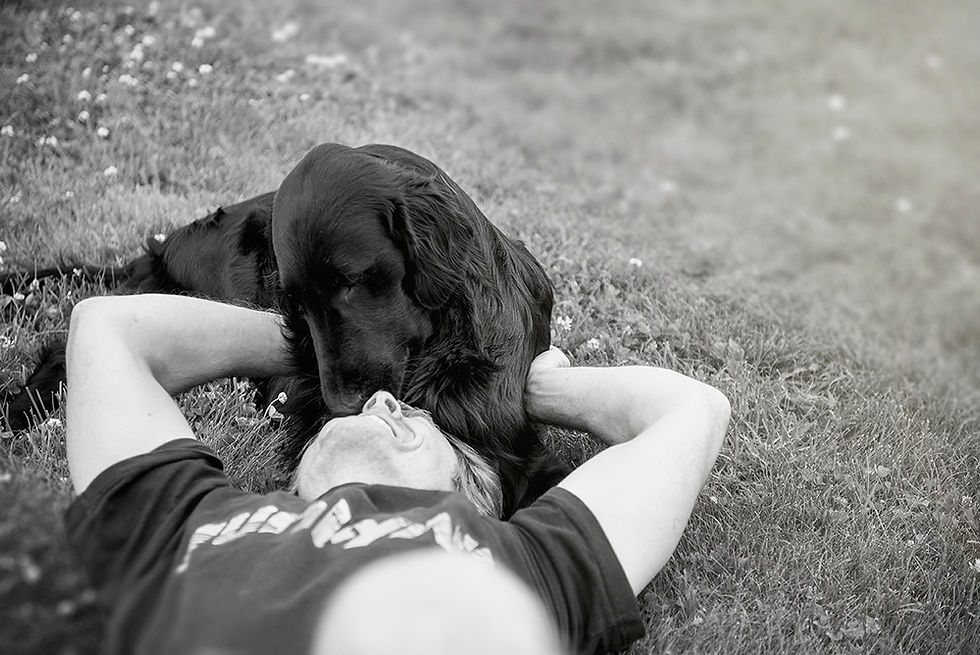
When the owner stays calm and present during the pause, the dog learns that pausing does not mean the connection or the fun has ended. Instead, the pause becomes a calmer part of the play. This can help the dog regulate its arousal, both during play and in other situations.
Play as a Shared Language
When play is used wisely, it becomes an arena where dog and owner practise cooperation without it feeling like a demand. The dog gains experience in following the owner’s signals, but also in the owner following the dog’s signals.
This is important. A relationship is not only about the dog listening to us. It is also about us listening to the dog.
Play can, of course, be used as a reward in training. But if we only see play as a reward, we miss something important. Play is also a way of building safety, joy, flexibility, and emotional regulation.
For the dog, good play with the owner can become an experience of mastery:
“I can become excited, but I can also calm down.”
“I can be surprised, but I am still safe.”
“I can meet something unexpected and find my way back to joy.”
“I can trust that my human will help me when things feel overwhelming.”
Perhaps this is where play has its greatest value. It gives dog and owner a shared language, a place to meet, and a safe way to practice joy, cooperation, flexibility, and self-regulation.
A Short Guide: How to Facilitate Good Play
Conditions that Need to Be in Place
Safety: The dog must feel safe with the person and in the environment.
Voluntary participation: The owner invites the dog into play, while the dog is free to join in, take a break, or step away without pressure.
Window of tolerance: The dog must be within a level where it can learn and regulate itself.
Noticing signals: The owner must be able to read the dog’s body language.
Pauses: Pauses should be a natural and warm part of the play.
How to Do It
Invite the dog to play with a small movement, sound, or toy.
Vary the play in small ways to maintain curiosity.
Add short pauses before the dog becomes too intense, and remain calm and present during the pause.
Resume the play when the dog is regulated.
End while the dog is still collected.
What to Focus on Along the Way
Emotional signals
Ability to regulate
Voluntary participation and choice
Intensity
Reciprocity
How Do You Know that the Play is Good?
The dog participates voluntarily and with joy.
The dog can regulate itself between sequences.
The dog can make contact during the play.
The body is soft and mobile.
The pauses help the dog become more collected.
In Summary
Good play is not about getting the dog as highly activated as possible. It is about creating a safe framework in which the dog can experience joy, mastery, voluntary participation, and contact with the owner.
When the owner invites the dog to play, reads the dog’s signals, includes pauses, and adjusts the intensity along the way, play becomes more than fun. It becomes a way to build relationships. It teaches the dog that it can become excited and find calm again, meet small surprises and still feel safe, and cooperate with its human in a way that feels good for both.
The best play is therefore not necessarily the most intense, but the kind in which the dog participates voluntarily, feels safe, and comes out of the session collected and happy with the owner.


Comments