
Dogs in School: How they create safety and motivation in the learning environment

A research-informed perspective on the role of dogs in modern classrooms
Across many countries, schools are increasingly integrating school dogs and animal-assisted services into their learning environments. This is not just about well-being; it is about strengthening learning, motivation and social safety. When a dog enters the classroom, something immediate happens shoulders drop, focus sharpens, and the relationships between children and adults soften and become warmer.
Dogs have a unique ability to meet children without judgement or expectations. For many students, this is a rare experience in everyday school life. A gentle look or a wagging tail can give a child a strong sense of value and belonging. For some students, this alone can make the school day a little easier and learning a little more accessible.

The dog as a bright spot and bridge-builder
One of the most underestimated effects of animal-assisted education is the simple power of having something to look forward to. Children who carry heavy emotions related to school often experience a positive shift just from knowing that the dog is coming. This anticipation creates security, regulates emotions and gives the energy needed to show up.
Dogs also bring an element of “unpredictable normality” into the classroom, which is particularly effective for regulating stress. Suddenly the dog rolls over onto its side and lets out a big yawn, or it falls asleep and starts snoring right in the middle of the lesson. These small moments create humor, relaxation and natural shifts in attention, giving children a mental breather when things feel difficult. When children and adults laugh together, the sense of community grows stronger.
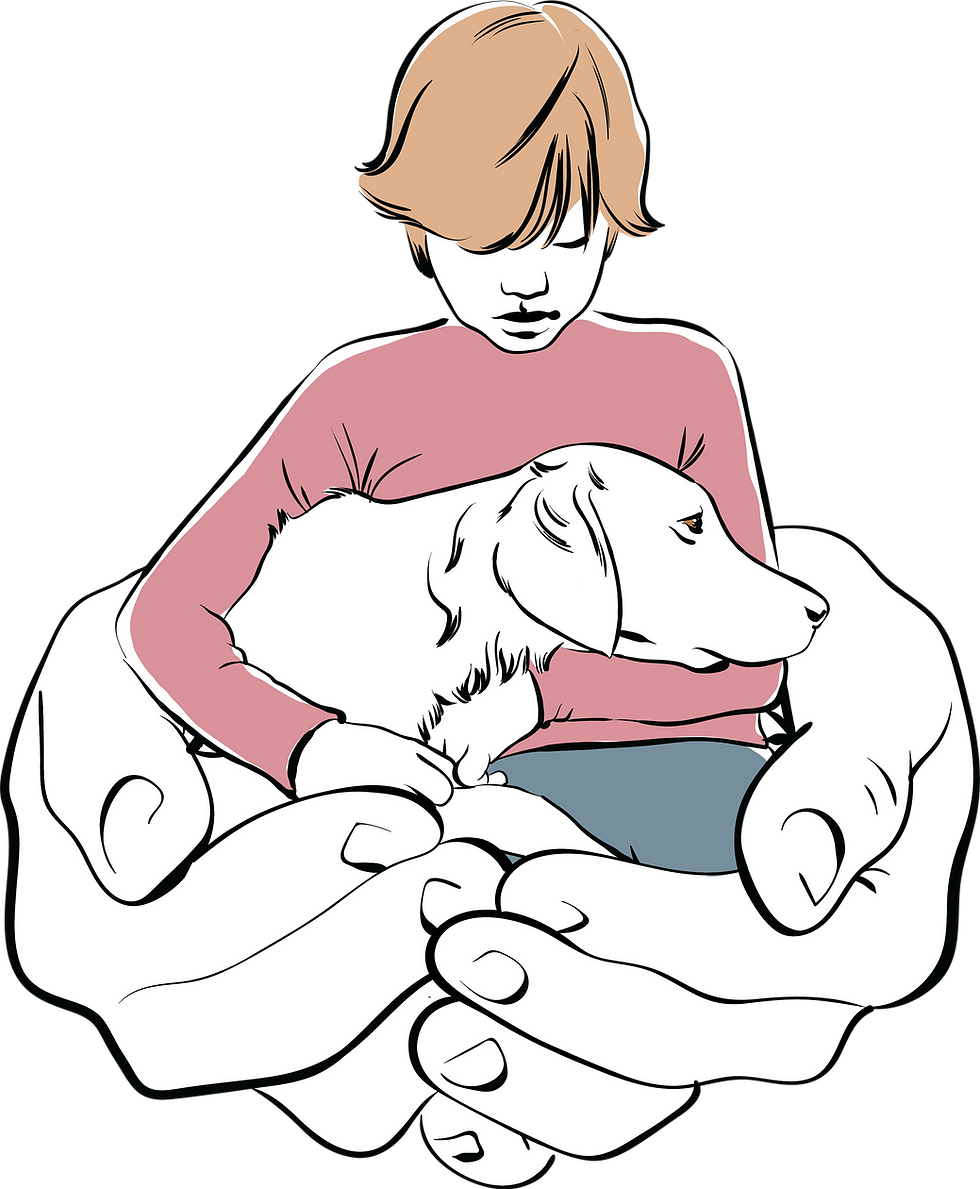
Relationships form the foundation for both learning and psychosocial development, and here the dog makes a significant difference. A school dog acts as a social bridge, making the teacher more approachable and lowering the threshold for participation. Students who usually hold back dare to come closer. Those who often feel left out more easily find their place. The dog creates safety, reduces social distance and contributes to a warmer and more inclusive learning environment.
7 Documented Effects of School Dogs
1. Increased motivation and joy of learning
A school dog makes learning more engaging and sensory-rich. This boosts curiosity, effort and a sense of mastery.
2. Improved concentration and focus
Dogs live “in the moment,” and this often rubs off on the students. Many children gain increased endurance and better focus during learning tasks.
3. Reduced stress and anxiety
The dog’s calm and non-judgmental presence provide social support and contributes to lower stress and tension.
4. Strengthened relationships in the classroom
Dogs make it easier for students to form connections with both the teacher and each other, which strengthens the learning environment.
5. Greater self-efficacy and practice competence
Through play and problem-solving with the dog, children learn to take risks, make mistakes and try again. This builds confidence and resilience.
6. Better support for diverse learning styles
Animal-assisted education is particularly effective for students who learn best through practical, tactile or physical activities.
7. Improved emotional understanding and social competence
As children learn to read a dog’s body language, they also practice interpreting emotions, boundaries and intentions in other people.
Summary
Including dogs in school is not just about well-being; it is about learning, mastery and safety. The dog creates calm, curiosity and positive relationships and helps more students enter the “learning zone.” Small, unpredictable moments with the dog provide natural relief in challenging situations and make the school day easier to manage.
School dogs build bridges between students and teachers, bring positive energy into the room and make learning accessible to more children. They strengthen academic development, social competence and children’s ability to dare, try, fail and try again, with safety and support.
FACT BOX: Dog at school
Question | Answer |
What is a school dog? | A school dog is certified together with its handler and forms a team that provides academic and emotional support to students. |
Why is it effective? | Dogs help reduce stress, increase motivation and create a safer, more inclusive learning environment. |
Who benefits most? | Students who struggle with attention, emotional regulation, social interaction, language, motivation or performance pressure. |
What does a school dog do during the school day? | Provides calm, promotes focus, strengthens relationships and motivates through activity and presence. |
Documented effects: | Reduced stress, better concentration, increased motivation, stronger relationships and greater confidence/mastery. |
Why consider a school dog? | Because a certified school dog team strengthens the learning environment and improves daily life for both students and staff. |
Further Reading
Drugli, M.B. (2012). Relasjonen lærer og elev: avgjørende for elevenes læring og trivsel. Cappelen
amm.
Edenburg, N. & van Lith, H.A. (2011). The influence of animals on the development of children. The Veterinary Journal, 190(2), 208–216.
Evensen, S. (2018). Dyrebar Relasjon – Hvordan kan dyreassistert pedagogikk forbedre relasjoner i skolen. Master’s Thesis, UiT.
Gee, N.R., Fine, A.H., & McCardle, P.D. (2017). How animals help students learn. Routledge.
Melson, L.G., & Fine, A.H. (2015). Animals in the life of children. In Handbook on Animal-Assisted Therapy. Elsevier.
Mooney, C.G. (2013). Theories of Childhood. Redleaf Press.
VanFleet, R. & Faa-Thompson, T. (2017). Animal Assisted Play Therapy. Professional Resource Press.
Villavicencio, F. T. (2011). Critical thinking, negative academic emotions and achievement. The Asia-Pacific Education Researcher, 20(1), 118–126.
Wilson, E. O. (1986). Biophilia – the human bond with other species.
Wohlfarth, R., Mutschler, B., Beetz, A., Kreuser, F. & Korsten-Reck, U. (2013). Dogs motivate obese children for physical activity: Key elements of a motivational theory of animal-assisted interventions. Frontiers in Psychology, 4, 296.


Ran into Brighterly's fraction calculator while helping a kid with homework and figured I'd share a few observations. The tool covers the basics, addition, subtraction, multiplication, and division across proper, improper, and mixed numbers. What sets it apart from most quick calculators is that it shows the intermediate steps, including finding a common denominator and simplification, which actually helps with understanding instead of just delivering a number. For anyone curious about how it processes specific inputs, the tool sits here https://brighterly.com/calculator/fraction-calculator/ and you can run your own test cases to see how it handles unit fractions or equivalent forms. The interface stays minimal, no flashy distractions, which I find more useful for learning. Still, any automated tool should be treated as…